Counter-Narrative or Just Noise? Sonny Liew on Art, Ambiguity, and the Responsibility of Storytelling

Updated: Jul 25
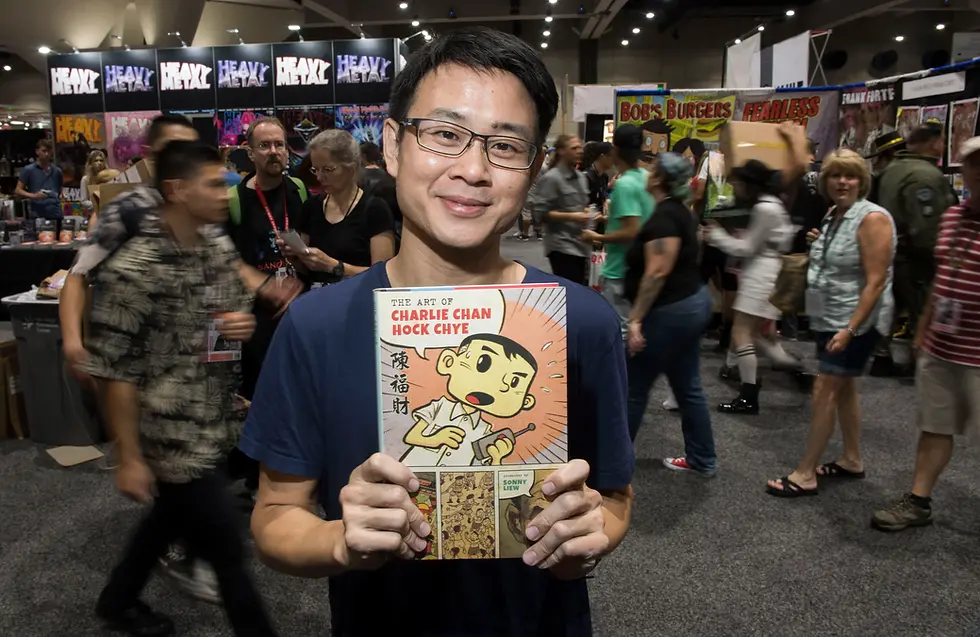
Photo: Comic-Con 2017, The Orange County Register
For decades, discussions surrounding art and public discourse have often been framed through familiar binaries: official versus alternative, dominant versus marginal, establishment versus resistance (Wulia). In Singapore especially, where questions of history, governance, and national identity are closely tied to public narratives, artists who engage with these themes are frequently positioned as counterweights to institutional forms of storytelling. Yet Sonny Liew appears notably resistant to this framing.
Liew, best known for The Art of Charlie Chan Hock Chye and first-ever Singaporean to win the Will Eisner Comic Industry Awards, has become one of Singapore’s most internationally recognised comic artists, often associated with works that blur history, memory, satire, and political reflection. His comics frequently revisit moments and figures that exist slightly outside dominant narratives. However, in conversation, he is far less interested in romanticising the idea of the “counter-narrative” than one might expect.
“I don’t think it’s a rare thing to want to explore non-dominant narratives,” he remarks. “We’re story-telling animals and competition to tell stories is intense.” For Liew, the issue is not whether alternative narratives exist, but how one distinguishes between robust critique and mere noise. Referencing popular mainstream figures such as Alex Jones and Joe Rogan alongside “flat earthers,” he points toward a more uncomfortable reality: alternative narratives are not inherently insightful, ethical, or even coherent simply because they stand outside the mainstream and act as "different" beacons of knowledge. The responsibility, he suggests, lies in rigorous research and critical judgment, though even that offers no perfect safeguard.
This skepticism extends to art itself. Although Charlie Chan Hock Chye is often interpreted as a challenge to official historical memory, Liew seems reluctant to position comics as superior vehicles for truth. “I would guess art forms part of that discourse,” he says, noting that no single medium necessarily holds greater legitimacy than another. Comics, however, may “come under the radar a little more easily,” aided by assumptions about their accessibility and informality. That accessibility creates possibilities, but not guarantees.
Ambiguity occupies a similarly cautious role in his work. Liew describes his storytelling less as an attempt to persuade readers toward a fixed interpretation than as an effort to encourage skepticism toward all narratives, including his own. “It’s hard to be certain about anything,” he admits. Yet his uncertainty is not nihilistic. Rather, it reflects a recognition that narratives are constructed within a crowded and unstable discourse ecosystem shaped by institutions, media, algorithms, popularity, and chance.
In that sense, Liew’s work offers less a politics of revelation than a politics of careful interpretation. The challenge is not simply uncovering hidden stories, but learning how to approach all stories, official or otherwise, with discipline, skepticism, and intellectual humility.
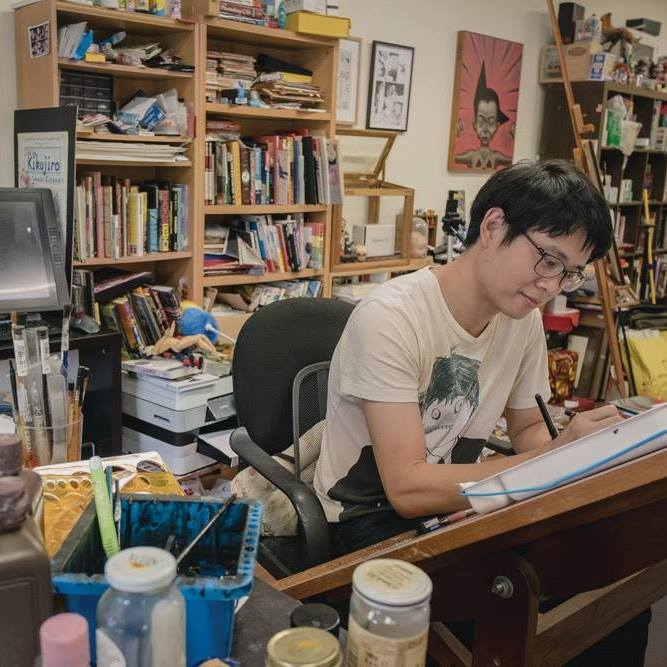
Photo: The Online Citizen
1) Your work often explores moments, figures, or perspectives that sit slightly outside dominant narratives. What draws you to these kinds of stories, and what do you think they reveal that more official or widely accepted accounts might miss?
I don’t think it’s a rare thing to want to explore non-dominant narratives; there seems to be heterodoxy in all fields? We’re story-telling animals and competition to tell stories is intense. Maybe the real issue is trying to grasp if you’re just producing nonsense (Alex Jones?), questionable ideas (Joe Rogan?) or actually robust counter narratives. I don’t really have an answer to that except that it means we all have the responsibility to do the best research we can. Though even flat earthers will tell you that, so….
2) In The Art of Charlie Chan Hock Chye and Pollyticks, there’s a sense that history and memory are not fixed, but constantly interpreted and reshaped. How do you think art allows us to engage with history differently from more traditional forms like textbooks or public discourse?
I would guess art forms part of that discourse? I don’t suppose any one form is superior to another, more that different people respond differently, so all parts of the discourse are valuable at some level. I would say comics by their part visual nature and developmental history (newspaper comics, superhero comics) can come under the radar a little more easily, thanks to the presumption of accessibility, which is both real and imagined?
3) Your work often leaves space for ambiguity rather than offering clear conclusions. Is that something you consciously aim for, and what role do you think uncertainty or open-endedness plays in how audiences engage with your work?
Heh, it’s hard to be certain about anything. I usually say that the work is not meant to tell you to believe in any particular narrative, even its own, and more to encourage critical thinking about all narratives. But of course I would still prefer it if it was possible to reach consensus through that critical thinking! (I don’t know if it does).
4) How do you think visual storytelling—especially through comics—changes the way people process complex or sensitive ideas compared to more direct or conventional forms of writing?
I think visuals can be helpful in many ways; IKEA assembly instructions may be a clear case of that. But most comics are also a combination of words and images, so the within-medium challenge is to figure which does what and how they interact?
5) In a society where certain narratives can become dominant or widely accepted, what role do you think artists play in expanding, questioning, or complicating those narratives?
Hmmm… as mentioned, artists (and everyone else) are one part of the discourse ecosystem. I’m not really sure who or what the dominant forces are these days? Social media? Podcasts? Schools? Art’s impact may depend on becoming viral or popular, I don’t know how much of that comes from the inherent quality of the work, and how much from chance and circumstance :p
6) Looking back on your body of work, has your perspective on storytelling or the kinds of stories you feel compelled to tell shifted over time? If so, what has influenced that change?
I think there are threads that can be drawn from start to present, but also shifts. A kind of wishy washy answer but it also feels true. Frankie & Poo was after all a kind of political cartooning. At the same time I’ve become less interested in cool illustrations for their own sake, even if I still appreciate the craft behind them. Or lack of craft, perhaps, when it comes to AI!
7) When you talk about the responsibility of distinguishing between “robust counter narratives” and narratives that are simply noise or misinformation, what do you think actually helps people make that distinction today, especially in such a fragmented, pretty polarized media environment?
That's a tough one to answer, since most of us think we can tell the difference, can make that distinction ourselves; a bit like most people thinking they are better-than-average drivers when it cannot possibly be true. Some things maybe we can discover facts about, but many things require so much expertise that we end up having to rely on authority at some level. And there will always be folks with strong credentials who are naysayers, and everyone will have incentives (financial, careerist etc) to stick to given narratives... On Youtube videos I'll sometimes see adverts for "Ground News", which is supposed to be a site that gathers news reports from all kinds of sources to make it easier to "compare news sources, read between the lines of media bias and break free from algorithms" (as their website claims). Maybe something like that is a start, though it still requires us to do the hard work of digging deeper...Maybe the truth will eventually be in the pudding, regarding things like climate change, or Trump's authoritarian desires... but then it may already be too late!
References
Wulia, T. (2023). Aesthetic resistance: publicness, potentiality, and plexus. Journal of Political Power, 16(2), 213–236. https://doi.org/10.1080/2158379X.2023.2245228
Liew, Sonny. E-mail interview. By Justin Park, 3 May 2026.
Picture Perfect Project, Article (V)




Comments