CapCut Edits and Voltage: Understanding Singapore's Underground Youth PMD and E-bike Culture

Updated: Sep 6
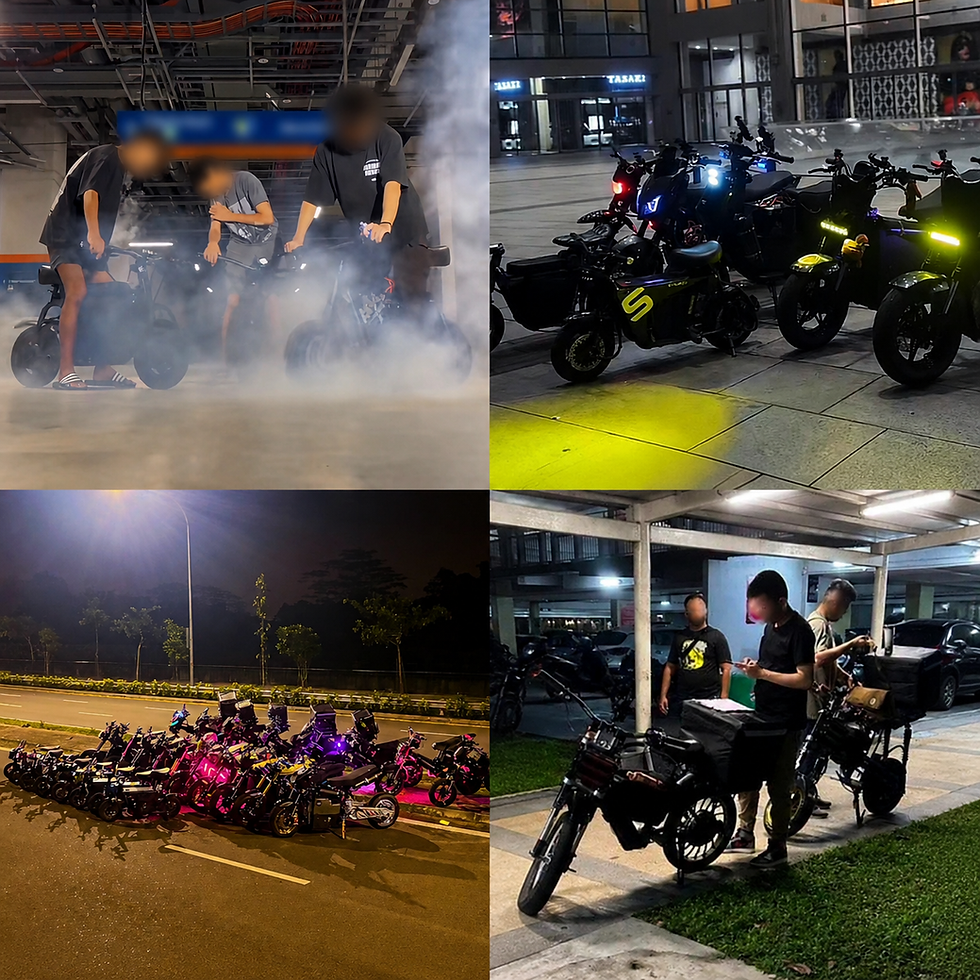
It is a quiet night along Singapore's northeastern roads. With barely a car in sight, one might assume the coastal highways are empty. Then, without warning, a convoy of adrenaline junkie teenagers speeds past. Portable speakers blast Chinese DJ remixes and Jedag Jedug techno songs into the night as neon underglows illuminate modified e-bikes and electric scooters. At first glance, they resemble ordinary motorcycles. A closer look, however, reveals something else entirely: illegally modified personal mobility devices (PMDs).
Many of these bikes far exceed the Land Transport Authority's (LTA) legal speed limit of 25 km/h for power-assisted bicycles. Travelling in groups, these riders have come under increasing public scrutiny and enforcement in recent years. Between 2023 and the third quarter of 2025, around 710 reported accidents involving PMDs resulted in injuries. More recently, in June 2026, a nine-day joint operation by the LTA and Singapore Police Force across hotspots including Sengkang, Punggol, and Yishun uncovered more than 200 offences and led to the seizure of 111 active mobility devices and motor vehicles.
On paper, it would appear that Singapore's underground PMD scene is slowly disappearing.
Yet a glance through hashtags such as #ebikesg and #sgebike on TikTok reveals a very different picture. Thousands of videos continue to surface online, documenting customised bike builds, late-night rides, and tightly knit riding groups. CapCut template edits featuring flashing lights, cinematic night rides, and booming Chinese DJ remixes or Jedag Jedug tracks have become a recognisable aesthetic of the community, attracting thousands of views and introducing users to the culture.

Photo: Social media posts under the hashtag #ebikesg, OP identities blurred for safety reasons.
In a country that prides itself on road safety and the strict enforcement of laws, this underground community continues to persist despite repeated crackdowns. The question, then, is not simply why illegal PMDs continue to exist. It is why so many young Singaporeans continue to be drawn to them in the first place.
To better understand the community beyond the headlines, I spoke with several youth riders about their experiences, what first drew them into Singapore's underground PMD culture, and why, despite the risks, they continue to ride.
Behind the videos of speeding bikes, flashing LEDs, and booming techno remixes are teenagers who tell a surprisingly different story from the one most Singaporeans are used to hearing.
I spoke with two members of Singapore's PMD community, both still teenagers. One was 17 years old and had been riding since 2023. The other first entered Singapore's PMD scene back in 2018, when modified Fiidos were only beginning to appear.
The vehicles themselves reveal how far underground parts of this culture have become. One rider described previously owning what he called "the fastest 72V chapter bike," a modified Yadea X5 that he said cost over S$5,000 and was "able to touch 200+ km/h"—a staggering claim in a country where LTA regulations limit power-assisted bicycles to just 25 km/h.
Despite this, neither rider denied that the hobby carries risks. One openly admitted, "I'm honestly a reckless rider myself, but I only do bad stuff if the road is clear and no harm will be affected to anyone." Both also acknowledged that irresponsible riders have damaged the reputation of the wider community.

Photo: Multiple different social media posts under the hashtag #ebikesg, OP identities blurred for safety reasons. These images are not related to the 2 listed interviewees in this article.
Yet when I asked what riding actually meant to them, neither started by talking about speed. Instead, they spoke about friendship. One rider said he first entered the scene simply because "friends introduced me into PMDs in Singapore."
Another remembered buying a Fiido for around S$2,000 because it was "small and easy" before later upgrading to a larger bike. More than anything, he said, riding was "just to have fun with friends and enjoy the rides."
That sentiment surfaced repeatedly throughout both conversations.
"Having fun with friends rather than playing phone nowadays," one rider explained. "Maybe earn a living a bit rather than seeing kids nowadays always on their phone 24/7."
The 17-year-old echoed something remarkably similar.
"I enjoy it most when you have friends to ride with, and this keeps me from doing bad stuff as a youth. I'd
rather ride around and have fun than make trouble outside."
That phrase—"doing bad stuff"—came up several times during our conversation. When I asked what he meant, he didn't hesitate.
"Drugs, violence, self-harm and other stuff. Teenagers can get stuff easily in Singapore."
He later added something that genuinely surprised me.
"Ever since I started playing ebike since 2023 I have no more police cases cos PMDs has kept me away from doing bad stuff."
For him, the bike had become less of a machine and more of an outlet. Another recurring theme was escape. When I asked what riding at night felt like, he described it as less about adrenaline than emotional release.
"To me it escapes from stress due to love and money... speeding is just a way to keep my mind busy."
He later added, almost as an afterthought:
"Cos as a teen all I have is feelings."
The second rider described the feeling differently but arrived at almost the same conclusion.
"It has helped me cope with stress," he told me. "Some people just want to have their own time while enjoying the wind and alone time."
Even the loud music that has become synonymous with Singapore's PMD edits on TikTok carried a different meaning in his eyes.
"Some even blasting music so that they can heal themselves. Of course blasting music will create public noise, but it's just a one-time thing. They hear the songs for like 10 seconds and off they go."
More than anything else, the two teenagers connected over how they believed others saw them.
"We are actually friendly in any way... but there are some people who abuse it, not all of them," one rider said. "The ones you see outside always waving at people and being friendly are the ones using the electric bike properly just to have fun and explore Singapore."
The other shared almost exactly the same frustration.
"I would like to see people try to see us differently. Some riders are reckless. Some of us are careful with what we do. I always try to follow rules even though my bike is illegal."
When I asked one rider the youngest PMD rider he had personally met, he answered almost immediately.
"Twelve years old."
The answer was startling. It hinted at just how young parts of this underground community have become, and how deeply rooted the culture is among Singaporean teenagers despite years of enforcement campaigns.
Several riders also mentioned using their bikes for delivery work whenever money became tight. Others simply described them as a reason to leave the house, meet people, and avoid isolation.
As one rider put it, "People change as soon as the public started to shout vulgarity to those people who are innocent and they just wanted to enjoy their life before it's too late."
He finished with a sentence that perhaps captures the mentality driving much of this subculture.
"YOU ONLY LIVE ONCE."
None of these conversations excuse illegal riding or dangerous behaviour. But they do reveal something often missing from public discussions surrounding Singapore's PMD community. Behind every "up lorried" confiscated bike or viral speeding video is often a teenager searching for friendship, purpose, distraction, or simply somewhere they feel they belong.
None of these conversations excuse illegal riding or dangerous behaviour. Singapore's regulations surrounding PMDs did not emerge in a vacuum. They were introduced following years of pedestrian injuries, fires linked to illegally modified devices, and a growing number of accidents involving non-compliant PMDs.
LTA has consistently maintained that illegally modified devices pose serious risks to both riders and the wider public. With fines and jail terms ranging from S$2,000 for simple possession up to S$20,000 for illegal modifications. Interestingly, even the teenagers I spoke to largely recognised why these regulations exist.
"LTA is just a ruin of our fun," one 17-year-old rider admitted. "But I understand they just want us Singaporeans to be safe and prevent us from getting injured. That's just the price we pay and play."

Photo: LTA enforcement of non-compliant PMD vehicles. Photos from Punggol Neighbourhood Police Centre/Facebook and Lim Yaohui ST.
That tension lingered throughout every conversation I had. None of the riders defended reckless behaviour. Each acknowledged that dangerous riding exists, that illegally modified bikes can cause serious harm, and that irresponsible riders have shaped how the public views the wider community.
What surprised me instead was how rarely speed became the centre of the discussion.
For all the modified batteries, custom high-volt builds, showy CapCut edits and late-night group rides, the conversations repeatedly returned to the same ideas: friendship, belonging, stress, purpose, and escape. The bikes themselves almost felt secondary. They were simply the vehicle through which these teenagers found community.
Perhaps that is why this underground culture continues to persist despite increasingly strict enforcement. Confiscating an illegally modified PMD is relatively straightforward. Understanding why a teenager is willing to risk losing it is considerably more difficult.
It is easy to dismiss Singapore's underground PMD community as reckless youths chasing adrenaline through illegally modified machines. Sometimes, that criticism is justified. But after speaking with the people behind the handlebars, I found something far more complicated. Behind the viral speeding clips and enforcement statistics were young Singaporeans searching for friendship, identity, purpose, and an escape from the pressures of adolescence.
Whether Singapore should tighten or relax its regulations is ultimately a policy question. But before we reduce this community solely to police operations, confiscated bikes, and reckless lost youth; perhaps it is worth recognising that every "up lorried" PMD also carries a story. Enforcement may remove the machine from the road, but it does little to answer the question that first drew me to this community: why do so many young Singaporeans continue to climb onto one in the first place?
Picture Perfect Project, Article (VIII)
The purpose of this article is to examine and understand Singapore's underground PMD community through the experiences of its participants. References to illegal devices or activities are included solely for reporting and public interest or possibly of fiction. All interviewees have been anonymised, and personally identifying information has been removed. Picture Perfect Project and its writers do not endorse/encourage illegal or harmful activities.
For enquiries regarding the legal use of PMDs, active mobility regulations, or road safety in Singapore, please contact the Land Transport Authority (LTA) at +65 62255 582.




Comments