Capitalist AI: A Word of Caution for Singaporeans
Updated: Sep 6
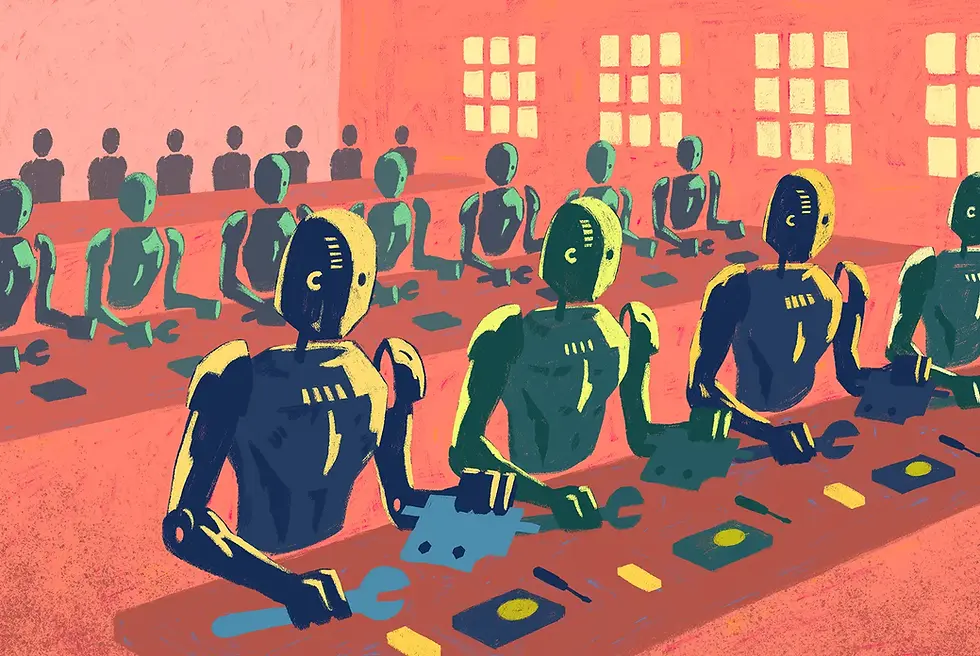
Photo: Caleb Luke Lin for Vox
In a previous article, published in RICE Media, I wrote of AI’s impact on the educational sphere. Writing of plagiarism and of a cognitive disruption to which my peers continue to be subject, I wrote mostly of AI’s shortfalls pertaining to young people. And though mentioning briefly its economic impacts, the article left much unsaid regarding AI’s relationship with wealth inequality and, broadly speaking, capitalism. As such, it is necessary that I consolidate such ideas into an essay, for consumption by Singaporeans at large. In this latest instalment of my written works, I hope to make apparent to Singaporeans the economic hazards which AI now poses.
Regarding ‘Capitalist AI’, AI’s relationship with human labour cannot be overstated. In economics, it is taught that two of the four factors of production (things which are used to produce goods and services) are labour and capital—capital refers to infrastructure like machinery, technology and, in this conversation, AI. Labour, of course, refers to paid human workers. Most goods are created using both of these factors; this, however, does not mean that both factors are used equally.
Economics will tell you that producers are profit-motivated—companies want to maximise their profits. After all, which company wants to sell a product that loses money every year? Since companies are profit-motivated, in producing goods, they will choose to depend heavily on either capital or labour based on which is cheaper to use. If it is cheaper to use, for example, a robot instead of a human to make a good, the company will do this, and a worker will lose his job. If we are to speak simply, it is only rational for a company to maintain a worker if he cannot be replaced by AI, either because AI is completely unable to do his job, unable to do it as well as the worker, or because such an AI would cost more to use than simply employing the worker.
You see what I am getting at now—AI capital (or in layman terms, AI tech used by companies) had not previously caused mass job-replacement because it was unable to replace the human worker—it either could not do the task entirely, or was worse than the human at performing the task. It was not because companies were so generous as to choose to let workers maintain their jobs, but workers were simply irreplaceable. But now, as AI progresses closer to superintelligence every day, it will become more and more economical for companies to fire their workers, choosing instead to maximise profits via usage of AI capital rather than human labour. This is not because companies are evil—companies are merely functioning as they are meant to, maximising their profits to the maximum degree possible and cutting their costs to as low as they can.
This is the reasoning behind my labelling of such a phenomenon as ‘Capitalist AI’. Because costs of production are now massively reduced, human unemployment decreases greatly. As this occurs, goods continue being produced by companies at lower costs, and hence greater profit margins. The result of this is obvious: the heads of firms, who own the means of producing these goods, become exponentially richer due to increased profit margins and decreased costs, while formerly-employed workers now face a lack of income and resultantly, have their standards of living reduced. Such is the phenomenon of ‘Capitalist AI’.
I foresee, at this point, a challenge to my assertion—who am I to say that AI will replace workers? Surely, the dichotomy between labour and capital is false. If workers adapt and learn to use AI efficiently, would they not generate greater revenue for firms, causing their salaries to rise? From 2027, all of Singapore’s universities, polytechnics and ITE (Institute of Technical Education) will teach their students skills pertaining to AI usage. Singapore’s Nanyang Technological University (NTU) plans to integrate AI into 40% of its courses by 2030 with the intention of “giving graduates an edge in an increasingly AI-driven economy”. Beginning in August 2026, AI Literacy lessons will be mandatory for all NTU students. If we arm our students with AI skills, do they not become more valuable to the companies they will come to join?
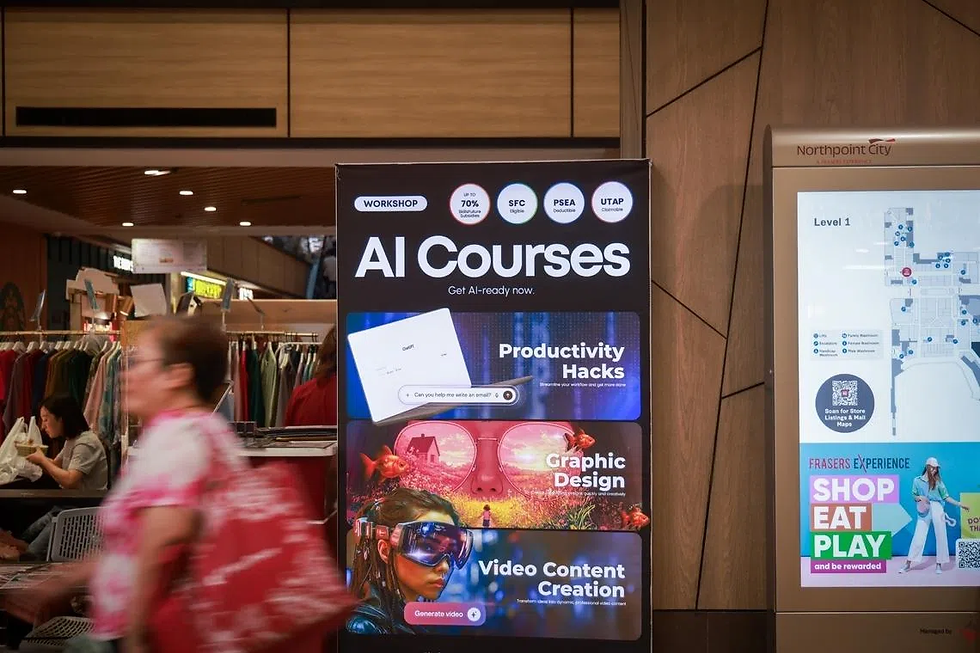
Photo: The Straits Times
This is untrue. To prevent replacement, or even to increase the salaries of workers, it must be that AI increases the productivity of the workforce without decreasing the demand for labour from firms. At least, if there is a decrease in firms’ demand for labour, there should be enough increase in the salaries of the remaining jobs to justify the increased unemployment. Is this the case? It is not- even the most ‘AI resilient’ jobs, perhaps a software engineer, are replaceable by highly-intelligent AI; it is foreseen that AI will soon become capable of maintaining and developing itself. When such a scenario occurs, the sole differential between human labour and AI capital will be the cost of employment per unit time. In a contest of cost-efficiency, human workers will lose. In the short-term, since ‘AI-literate’ workers can generate greater revenue, it is true that the salaries of adaptable workers will increase. In this short-term sense, the dichotomy between capital and labour is not binary. It is, however, naive to imagine that this temporary increase in the salaries of ‘AI-literate’ workers will persist; it is highly possible that after a temporal rise in efficient labour for firms will come the ultimate efficiency—replacement of the human worker altogether.
Amidst Singapore’s push to become an ‘AI hub’, we must reckon with what comes after the initial excitement. The human worker is undeniably under threat- we cannot solve this through any amount of ‘AI literacy’.
AI will grow Singapore’s economy, the economy will produce more goods and services, and firms will become more productive. The question is this: will Singapore’s working class benefit from this economic stimulation? I remain sceptical.
When firm-owners have greater profit margins and formerly-employed workers have smaller incomes, what is bound to happen? Firstly, it is self-explanatory that firm-owners, who now use mostly AI in their production processes, will get richer. On the other hand, their former employees will get poorer. They may attempt to cut back on spending to maintain their savings, but there are certain necessities which these former workers cannot help but purchase, such as food, housing, clothes, electricity, water, and so on. If these goods are produced by privatised producers (as they often are), who now largely use AI to produce these goods, then even through such spending on essentials, firm-owners grow in wealth. As AI progressively replaces more and more jobs, the proportion of the population who are employed decreases while their former employees have production costs further and further shrunk. Eventually, what will result is oligarchy— while the economy is technically productive, it is the firm-owners who benefit in wealth while the working-class face growing economic insecurity.
I humbly request the Singaporeans reading this article to consider AI’s relationship with capitalism, wealth inequality and inequity. Though the economy will grow under AI’s influence, will the middle class benefit from this economic growth? And if not, what purpose does AI serve, other than to lengthen Singapore’s existing wealth divide? It is possible to share AI's benefits more equitably among citizens, yet the version of AI advancing before us seems to have excluded all but the hyper-wealthy from its ambitions. Ironically, while multi-millionaires and billionaires are invited to give extensive speeches on AI, it is the voices of ordinary workers, those who now face the prospect of permanent replacement, that we seem to disregard as their bosses and CEOs monopolise not just the economic market but also the arena of public discourse.
About the Author
Jayvier Chua is a Singaporean youth whose work is multi-faceted in approach, but falls broadly under the humanities and social sciences. His policy work on algorithm governance earned Second Runner-Up at the 2026 Singapore Youth Policy Competition, while his literary development includes the Ministry of Education’s Creative Arts Programme Mentorship Attachment, and third place in Poetry Festival Singapore’s 2026 Write & Burn! Spoken Word Poetry Competition. He is also the founder of Youth for Humans (@youthforhumans), a Singapore-based youth initiative advocating for the ethical and responsible use of artificial intelligence.
Picture Perfect Project, Article (IX)


Comments